01
What is a Handpan?
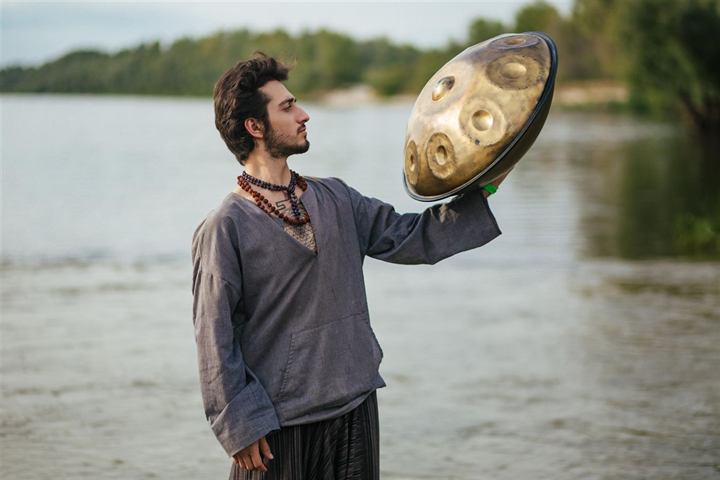
The handpan is a steel instrument played with the hands, descended from the Hang and the steelpan. It produces warm, resonant, harmonic tones and is tuned to a specific musical scale — there are no wrong notes, which makes it deeply intuitive for beginners and expressive for advanced players.
02
Popular Scales
The scale determines the mood of your instrument. Here are the most common starting scales:
D Kurd
Warm and grounded — the most popular beginner scale.
D Celtic Minor
Bright, melodic, great for storytelling melodies.
Amara / Equinox
Spacious and meditative — popular for sound healing.
Integral
Versatile and balanced — works across many genres.
Try it now
Listen to 9 different handpans
Each handpan is tuned to its own scale, and the scale sets the mood. Tap one to hear it from the lowest note up, then play it yourself (keys 1–9 work too).
Now playing: D Kurd
03
How to Choose Your First Handpan
Don't buy your first handpan alone. Material (steel vs. nitrided steel vs. stainless steel), number of notes (8–12 is ideal for beginners), and scale all affect sound and price drastically. I help every student choose an instrument that fits their budget and musical taste — ask me before you buy anything.
D Kurd 9+1
From €1,700 · TERRASTRA
D Celtic 9+1
From €1,700 · TERRASTRA
C Amara 12+3
From €2,500 · TERRASTRA
Prices and availability change — check the shop for the current catalog. Ask me first if you're not sure which scale fits your style.
04
Care & Maintenance
Handpans are sensitive to humidity and temperature. Always dry your instrument after playing outdoors, oil it every few months to prevent rust, and store it in a padded bag. A well cared-for handpan can last a lifetime.
05
Glossary
Ding — the central top note of the handpan.
Gu — the bottom hole used for bass tones and air sounds.
Tone Field — each individual playable note dimple.
Scale — the set of notes the instrument is tuned to.
Slap Tone — a percussive sound made by slapping the shell.
Mutant — a handpan with a custom or hybrid scale.
Live Performance · YouTube
This is what the handpan actually sounds like
Want to go deeper?
All of this becomes second nature once you start playing. Book a lesson and learn it hands-on.